

Beckmann Lab - Research
- Research
- Translation Quality Control
- Ribosome Biogenesis
Translation Quality Control
During translation ribosomes don’t progress at uniform speed and some ribosomes slow down or even pause during translation. Prolonged stalling of ribosomes serves as a proxy for problems during translation, e.g., caused by stress, features of mRNA or slowed peptide-bond formation. Here, ribosome collisions play a key role in defining which downstream pathway is triggered. The first aid system to resolve collisions is the RQC pathway, that starts with E3 ligase ZNF598 (Hel2 in yeast) sensing ribosome collisions leading to (poly-)ubiquitination of small subunit ribosomal proteins (uS10 and eS10). This is followed by splitting of the stalled ribosome by the RQT complex (ASC-1 complex) into 40S and mRNA that is subsequently degraded, and a 60S still bound to the arrested peptide and tRNA. The latter serves as a substrate for the RQC complex that has a dual function: it adds a short C-terminal tail mostly consisting of alanine to the arrest peptide and it is able to polyubiquitinate lysines from the emerging nascent polypeptide chain. Both functions lead to degradation of the arrest peptide.
In case of more persistent stalls when the RQC system gets overwhelmed, anti-stress pathways are triggered such as the integrated stress-response (ISR) or the ribotoxic stress response (RSR). Key factors for collision-dependent activation of ISR are GCN1 – a collision sensor and GCN2 – a kinase that phosphorylates eIF2a to shut down translation. In some cases GCN1 can also mediate mRNA decay via the CCR4-NOT complex.
RSR is triggered by kinase ZAKα – another collision sensor that dimerizes on stably stalled colliding ribosomes, where it gets hyperphosphorylated and activated by a yet unknown mechanism. Once active, ZAKα targets kinases p38 and JNK to trigger cell cycle arrest and apoptosis, respectively.
The goal in our lab is to understand the molecular principles of ribosome collisions and how colliding ribosomes interact with different collision sensors to trigger and/or activate downstream pathways. Using cryo-EM and Single Particle Analysis, we structurally characterize intermediates of collision-dependent RQC, ISR and RSR pathways to elucidate mechanistic details of their activation and in ideal case the interplay between these pathways.
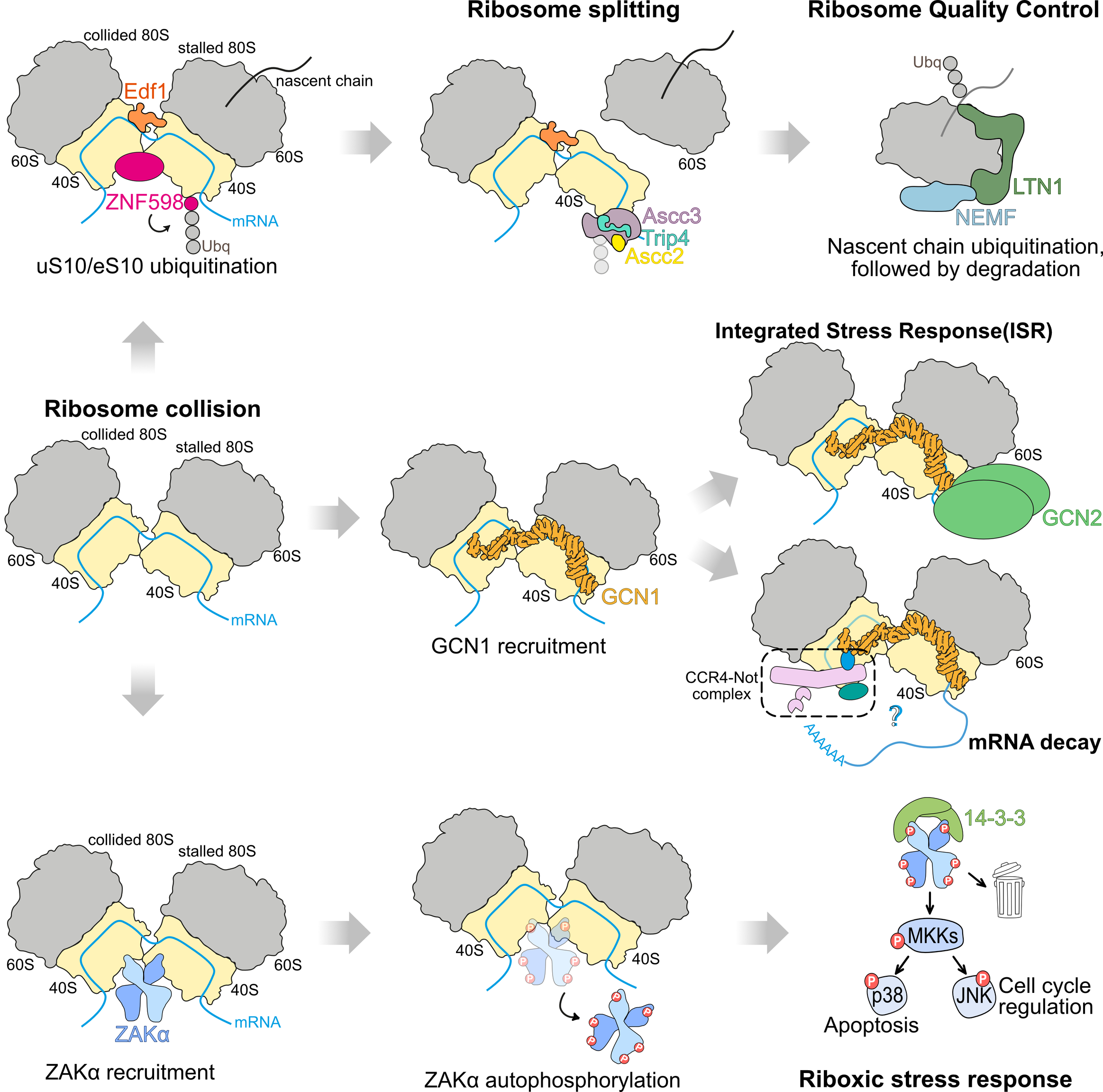
Overview of translation quality control mechanisms investigated in the Beckmann group.